Translate

Wednesday, January 6, 2021

Writer Igniter Reading Challenge [Protagonist(s)]

     There's something about a relationship described in an epistolary format that immediately evokes a nostalgic sensation for me.  We didn't even need the recent empirical study linking the reading of fiction to the practice of empathy, once that familiar scent tickles our noses we know that this is a flower we have sought out and perhaps smelled before.  I have heard that olfactory sensations have the deepest connection to memory of the senses but I have not done a double-blind, peer-reviewed, placebo-planted study myself.

Each time I smell the durian fruit, I think of you, my dear


    In This Is How You Lose the Time War, much of the action is in the form of an unusual exchange of correspondence between the two main characters, Red and Blue.  I am not sure which one of them is the protagonist as they are equally prominent so far but I am leaning toward Red a little, maybe only out of my own bias.  I feel like I can identify with her a bit more and because of that I see how Blue intrigues her so.  Both of them exist in a world very far removed from our own and their archaic method of non-instantaneous communication serves to humanize them.  Their occupation seems a lonely one, inviting a chance for connection, even if it be unsanctioned.  I can't wait to see where things go.

Lots of folks couldn't wait to see where these would go, too.


Sunday, December 27, 2020

Writer Igniter Reading Challenge (Prelude)

     Alas, I have no witty title.  I am borrowing this one from DIY MFA wherein I will be embarking on a reading challenge to become a better writer through reading with the writer's lens.  Was this one or that one clearer?  Can I see the other one again?  Are those supposed to be letters?


    I have selected the book I will read for the challenge thanks to insights gleaned from one of my favorite podcasts: LeVar Burton ReadsDuring this adjective-defying year, I've found a great deal of nostalgic comfort in having LeVar Burton read me a story once again.  I have been introduced to many new writers including Amal El-Mohtar, whose short story "Pockets" drew me in and led me to her book This is How You Lose the Time War, coauthored with Max Gladstone.  The cover features neither space-ships nor ray guns but two phase-shifted birds.  Why wouldn't the interest of yours truly be piqued?

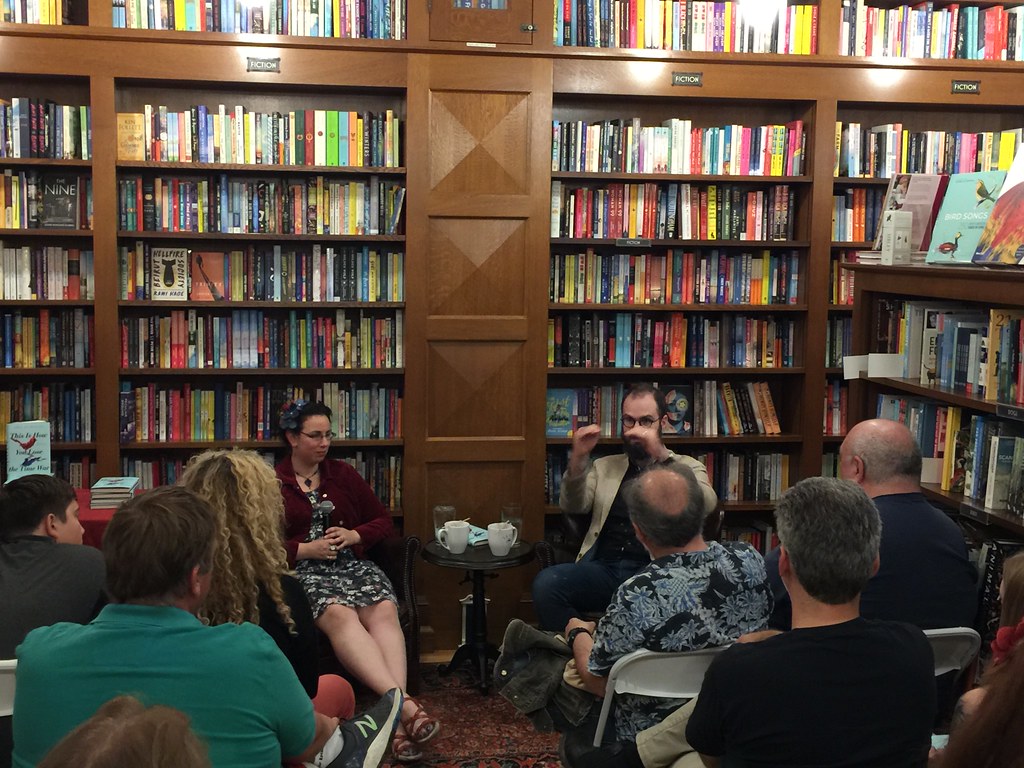
Here is a lovely photo of the authors discussing their book ("9/13/19 Amal El-Mohtar and Max Gladstone (This Is How You Lose the Time War)" by banksquarebooks is licensed with CC BY 2.0.  To view a copy of this license, visit https://creativecommons.org/licenses/by/2.0/).  It is obviously of the pre-Covid era.  You can see the book on the far left.  See that other light blue book propped on top of the shelf in the upper right?  It's called Bird Songs and has recordings that go along with each bird's page.  Now how do I know that?  


  (A tiny sliver of my bookshelf...bookshelves)

Well, that's the end of this prelude (violin ceases playing).  The Challenge is afoot!  


Tuesday, July 28, 2020

Pandephonium, or the Ill-Tempered Klavier

     One of the positive things that has been suggested to emerge from the pandemic is an explosion of artistic creation.  I am finding difficulty scrounging the necessary optimism; museums and concert venues will of course need to be open in order for us to fully partake of this creative cornucopia.  But this brings me to yet another dismal prospect: will we eventually run out of music?
   
     I always get at least half a chuckle out of typing part of something into the Google search bar and reading the suggestions.
Will we run out of ...food, water, meat, oil (in Florida, our idea of prepping for an emergency means hurricane prep.  Everyone gassed up their cars and spare tanks then watched Covid come along and drop oil prices like pants in a busy restroom)...phone numbers.
     Let's pause on that last one.  In the US, our phone numbers consist of a three digit area code followed by a seven digit number.  Each one of those digits can only be occupied by a value of 0 to 9, inclusive.  I'm no probability expert nor gambling enthusiast but I can say that there is a limit to how many number combinations can exist given those parameters.  But we could always make them longer, infinitely so.
     Music as we know it may not be so fortunate for one important reason: there is a limit to both the frequency range audible to the human ear and the ability to differentiate between two notes of similar frequency.  The unit of measure for determining differences in pitch is the cent.  If you locate an "A" on a piano, you will see a black key to the right and to the left of it.  The key on the right is an A# (more commonly known as a B-flat) and it adds 100 cents to the A's pitch.  On the left, you have an A-flat which is an A with a dollar-off discount, i.e. 100 cents lower.  
If I had a nickel for every song that follows a I-IV-V-I chord progression...
     Interestingly enough, there a lot of physicists and musicians weighing in on this topic (according to my internet search, at least).  In western music, we use a system (i.e. the notes on the piano) that divides an octave (an "A" to the next "A", for example) into 12 units of 100 cents each.  However, that's just western music.  In other parts of the world, much cheaper notes are used and therefore you can afford to have more notes and therefore more music, very efficient.  How low can you go?  Experts give ranges of 5-25 cents, lower than that, and it sounds the same (check out the audio demos on Wikipedia here). 
    So given these limitations on pitch (I'm leaving rhythm out but it would seem similarly constrained), I think there is a limit to the music that can be made and heard.  Will we reach that limit anytime soon?  Not a chance, despite the similarities found in common radio drivel.  Two artists who immediately come to mind as innovators in pitch and tonality are Aphex Twin and Deftones.  Always choose unsavory intervals (click the link for another post on the science behind musical notes).


Sunday, June 7, 2020

Pan Grigio

    By now, you should have stocked up on $30 worth of tax-free batteries for all your essential battery-operated devices if you, like me, reside in the Sunshine State (which, incidentally, is reporting an 80% chance of rain for every day next week).  You should also be proudly displaying a mask dangling from your rear view mirror, much like the CDs of yesteryear.  Hopefully you got to experience the renaissance of drinking at the bar, especially if your mixology skills are limited.
A friend asks, "What do you drink whiskey with?"  My response: "With ice."  My colleague's response: "With friends."
     Speaking of booze, I had to get creative with my breadmaking endeavors (see my recipe) and substitute wine yeast due to the paucity of bread yeast available at the store.

The wine I produce from the muscadine growing in an unattended corner of my backyard is all the rage with oenophiles these days.  Ask your sommelier how you too can be the proud owner of this carefully crafted vintage. 


  Just as I would before embarking on any "spontaneous" venture, I googled it first (sad affliction of our times) and found that people were indeed doing it with some degree of success but a larger quantity of wine yeast is needed because carbon dioxide isn't the principle desired byproduct of such a yeast.  So I proofed my expired Premier Blanc and let it meet my also rare and now prized flour to an acceptable result.  Blue ribbon in the county fair, no, but a fine canvas for a slather of peanut butter during a pandemic.     

Sunday, April 26, 2020

Blogging is Masturbation too, Right? Or is it Exhibitionism?

     Let's talk about the proverbial elephant in the room.  Blogging is merely a 21st century form of the diary/journal placed on public display.
Well, by that definition, it's kind of like graffiti
    I'll confess, my relationship with the concept of diary/journal is a bit maligned.  It was one of those things you had to do as a child of my generation.  If you were female, it was called a 'diary' and it was often some hideous pastel color complete with a cheap, sorry excuse for a lock that was supposed to protect the clandestine nature of your most profound secrets, i.e. the boys you liked, because that is all little girls are supposed to think about...sugar and spice and everything nice.  

But not real leather.  Or is that suede?  How would I know?  It's like when people refer to areas of the body like 'flank.'  I don't know a flank from a loin from a filet.  I do know the difference between tempeh, seitan, and tofu, however.
I always insisted on the seemingly gender-neutral "journal."  But it still was an awkward, forced exercise that definitely smacked of masturbation in nature.

Note: If all this talk of masturbation lacks context for you, please see my previous blog post "Insert Inspirational Cliche Here"   

Fast-forward more years than I care to admit (I was alive when the object in the first photo was still erect) and I now have a blog.  Have I forayed into the arena of exhibitionism?  Well, that would only be the case if someone read my blog.  

Cue the crickets...
I can't help but feel like random musings or secret loves or whatever people deem worthy of journalstuff is an impractical pursuit at best and narcissistic at worst.  I tire of hearing how therapeutic journaling is, how cathartic (Can somebody say...masturbation?).  Then I stumbled across this opinion article in Time and started to revisit some of these notions.  You are asked to think of the activity in the context of a historian looking for truth.  Truth is raw and ripe; unpolished and unedited.  Uncensored, even.  After years pass, we are able to give a more sanitized and presentable account of our "truth", filtered through our biases stemming from our own personal narrative and our sense of meeting others' expectations.  History is fraught with dishonest representations and perhaps it is our duty to help provide a candid, fresh account of these unforgettable happenings (or should we call them not-happenings?).  I may even have some selfish motivation; I think I want to write down some observations and sensations just so I remember, so I can put the future in correct perspective.  What it was like to feel a new level of social awkwardness as the etiquette changed day to day based on new findings.  What it was like to stay away from people to protect them.  What it was like to meditate on Zoom.  What it was like in the hospital without visitors.    
    But as soon as we commit observations and sensations to word, or merely to think these things, we lose their essence, their immediacy.
"The first rule of Fight Club is: you do not talk about Fight Club"
But we might have a better chance of remembering and telling the story we need to tell.


Saturday, April 11, 2020

Coronapocalypso

The empty roll...a symbol of our times?

     
     I make a solemn promise to you right now.  I'm not going to mention the 
C-word at all in this post.  Not a Peep, despite tomorrow being Easter.

I'm not going to utter the P-word either.


Nor the V-word.

        Instead, I am going to share a recipe with you.  

Did you snatch the last loaf of bread?

Fresh Bread (with Make-Ahead Dough)

2 cups warm water
1 tsp Active Dry yeast
pinch of Kosher salt 
4 cups room temperature flour

1.  Combine flour and salt.  Add yeast and let sit at least 30 seconds.
2.  Mix with water and stir until uniformly wet
3.  Cover bowl with aluminum foil and let rise at room temperature for 2-5 hours.
4.  Refrigerate.
5.  When you're ready to make fresh bread, grease a loaf pan and put dough inside.  Let it sit at room temperature for a half hour.
6.  Preheat oven to 450 degrees Fahrenheit.  Sprinkle dough with flour and drizzle with olive oil.  Stick it in the oven for a half hour.   


Wednesday, March 18, 2020

CoronaFest 2020

CoronaFest 2020: La Cerveza por los Tiempos Enfermos 
     You can rest assured that Deluge of Lethe is monitoring the COVID-19 situation closely and we have made the difficult decision to try to post more frequently in the event that elective procedures at the hospital are cancelled and Jen becomes relegated to the category of "nonessential personnel" (only hearts are in my scope of practice, i.e. I don't do sputum and droplets.  We have a joke in healthcare that we select our fields based on which bodily fluids bother us the least.).  Please know that your health and safety remain our number one priority and that is why we recommend the practices of washing your hands after handling soap bottles, disinfecting your friends/family/pets, not venturing out without full hazmat gear, eating green leafy vegetables (unless you take warfarin), and using social distancing to your advantage ("I'm not antisocial - I'm corona-conscious.").  Is anyone else thinking nostalgically to themselves..."why wasn't social distancing a thing when I was in high school?"  How refreshing it is not to need an excuse for sitting alone, it's the new cool.  But not as refreshing and cool as a bottle of Corona with lime, a joy that is rapidly evaporating as bars in Florida close down for thirty days of teetotalism. 
Coronavirus.  No, just kidding, it's actually herpes.
    OK, hopefully by now I've been able to put a smile on your face (remotely, of course) in these difficult times.  When this all blows over, I think it's our civic duty to go out and have a Corona (for illustrative purposes only; I'm not on InBev's payroll) at our local drinking establishments.  Remember the folks who depend on tips and who are not making money during this time (in addition to probably not having paid sick time or health insurance).  
     

Sunday, March 1, 2020

Juxta-poser


     OK, so what could Walden Pond and The Scream possibly have in common (yes, that is the actual Walden Pond, not a random photo produced by Creative Commons' search engine as a response to the query "tranquil pond."  What kind of charlatan do you take me for?)?  Thoreau and Munch were not contemporaries but they just barely missed the overlap - Thoreau died in 1862 and Munch was born in 1863.  In Walden, Thoreau reveals the unsettling news that "the mass of men lead lives of quiet desperation."  I think his choice of the word quiet is especially significant; poignant, even.  Walden Pond is quiet but The Scream certainly is not.  Of the two, which is preferable?  How many times do we find ourselves outwardly expressing an image of poised stillness such as Walden Pond while inside we are the very essence of this hairless person halted in a mid-fjord traverse by an overwhelming sensation that aligns us, without our express consent, with a primal anguish from the collective unconscious?        

Saturday, February 22, 2020

In a Nutshell

  Given the gravity of some of my more recent posts, I have decided to introduce a bit of levity by sharing a culinary suggestion.  Next time you find yourself in need of pesto for your gourmet Italian dish, you generally will have two options: use a jar of store-bought (I've heard Aldi's is passable) or DIY it.  It's a simple enough thing to make: garlic, basil, olive oil, pine nuts...all crushed together by a mortar and pestle (or the modern day version, i.e. the food processor, although it lacks the stress-relieving benefit).  But what about those pine nuts?  Bane of a budget!  I have a sneaky substitution: raw, unsalted peanuts.  There's no reason to take out a second mortgage on your house for pine nuts.  Cheap and nutritious, the humble peanut is an unsung hero of the kitchen, especially for us herbivores.  George Washington Carver said it best (in his guide How to Grow the Peanut and 105 Ways of Preparing it for Human Consumption):

  "I doubt if there is another foodstuff that can be so universally eaten, in some form, by every individual."

George Washington Carver: horticultural genius and pioneer of plant-based protein (before it was cool)
    I'm sure you've been thinking to yourself: "Wow, Jen has placed an inordinate number of colons in this post and colons make me think of intestines which of course brings up (pun always intended) the subject of digestion and therefore food...I'm hungry!"  Don't worry: if you click on the link to Dr. Carver's booklet, you will find many of his peanut recipes.   

Sunday, February 16, 2020

For Whom the Bird Calls

i tried to find you.
in vain, did i scan the treetops and the underbrush
having researched your favorite berries,
your morning and evening songs,
your profile both perched and with wings fully expanded,
your shadow, even.
i waited for you but you never came.
i was ready:
locked and loaded
(my binoculars).

"Visionaire dodo Army" by *SHERWOOD*
     Things proceeding unchecked, animals are finding themselves changing status: not from "Single" to "In a Relationship" to "It's Complicated," but from threatened to endangered to extinct.  As human beings, we are left with a painful exclusion from our experience of the world's potential biodiversity and much more pragmatically, an irreversible break in the ecosystem...potential effects often unknown until more damage is done.  If you get a chance, watch Last Chance to See (irony always intended).  It's a documentary follow-up of the 1989 BBC radio series of the same title where Douglas Adams travels the globe in search of endangered species in their natural environments. 
     I had the privilege of seeing Todd McGrain's sculpture collection of extinct North American birds (The Lost Bird Projectand I found myself struck by the poignancy that the only existence these birds now had was as art...as representations.  More sobering still was the word that The Lost Bird Project uses to refer to these representations: memorials.    
     I never could find the white-crowned pigeon despite searching relentlessly last time I was in the Keys.  And most certainly did I miss the ivory-billed woodpecker, now the stuff of legends.
An artist's rendering, unfortunately
     In light of these dark reminders, I find myself watching birds with a bit of restraint and uncomfortable pause, wondering if it might be my last chance to see.

Wednesday, February 5, 2020

Road to Dystopia

     This life is the epitome of luxury, though it teeters on the threshold of desperation.  It was an uncomfortable dichotomy of feeling mercifully yet momentarily safe while absolute chaos emerges nearby that I took away from reading Octavia E. Butler's Parable of the Sower.  I had no idea what to expect from the book initially.  I was in the local library, perusing the shelves for a sci-fi book that wasn't as much sci-fi as it was literature; i.e. something that would, for thematic reasons, be necessarily categorized as 'sci-fi' but was essentially just a very well written story about weighty issues worthy of contemplation, as opposed to an action packed spaceship/alien adventure.
    I suppose it is a bit like online dating.  You know you are seeking this specific type of individual who is a "genre outlier" but all you have at your disposal are some profile pictures and if you click on them you can see a short blurb about them.

"The library is closing in ten minutes.  Please bring your final selections to the circulation desk.  It is now too late to apply for a library card."  

  So I did the inevitable, the unavoidable, the ethically unthinkable...I judged books by their covers.  I weeded out any sporting spacecraft.  I alienated aliens.  I demoted any featuring fancy future military insignia.  For some reason, our library combines sci-fi and fantasy so I had to slay a few dragons too.  But then I saw it, a very unassuming book, pages slightly yellowed and dogeared, with a cover featuring a hand holding a book.  It didn't even look like a sci-fi book.  I didn't read the blurb on the back cover but I did read the first paragraph and the writing was clearly on point.

     Parable of the Sower is an eloquently written and absolutely harrowing story that grips you from the first chapter and doesn't relent; I actually read all 350-ish pages in one weekend, unable to put the book down because I was so concerned for what would happen to the characters in their precarious world.  This is one of the most plausible dystopian scenarios I have ever read or seen, rife with the effects of global warming (it was written in the mid 1990s), unchecked corruption and corporate greed, and the extreme results of societal distrust that has emerged as the zeitgeist of our past decade.  The narrator is an intelligent and pragmatic teenager living in a gated community outside of Los Angeles.  By gated community, I mean a neighborhood that has a huge wall around it, topped with broken glass and "Lazor" wire in an attempt to keep out not only rampant arsonists and other violent criminals but also the large homeless population who are forced to scavenge for their basic needs. 
    In high school I remember reading such cautionary tales as Brave New World and 1984 but Parable of the Sower seems much more likely and therefore, more frighteningly poignant.  It is a disturbing reminder of what happens when people are pushed to the bottom of Maslow's hierarchy of needs: what choices they are forced to make from there and of how much life they are denied access.


Friday, January 24, 2020

Tannenbalmed

      It drapes and it smothers; it hides and it strangles.  Meet kudzu: the bane of abandoned buildings along Florida's roadsides.  It grows quickly in our subtropical biome (as do insects...come to the Sunshine State and you too can witness the world-famous Palmetto Bug flying through the air with the greatest of ease before alighting on your shoulder faster than you can say "Kafka").
Structures into which people once entered now become the skeletons of looming kudzu monsters; their odd shapes casting equally odd shadows beneath unflinching and unknowing light.
In the middle front, I think I see the fear monster from the Lost in Space episode "Space Creature."  There is a very memorable line from that show where the creature announces his true identity: "I am your id!"  From context and pronunciation it seems safe to assume he is referring to the Freudian term.  And would it not be like an id, to lie obscured beneath a thick layer of seemingly innocuous, verdant foliage?       

Saturday, January 4, 2020

The Osprey

You know it has crossed your mind before.  Such a shrill, whining call seems inappropriate for someone such as myself: my majestic wingspan, piercing eyes, gnarled talons embedded inextricably in the flesh of my prey.  My name is synonymous with strength, agility, and tenacity and you use my monikers for all kinds of your human things from medical equipment to planned communities.  Speaking of medical equipment, you didn't like it when I made a nest atop the flat surface of this tank outside the hospital.  You wanted to keep me out, so you placed this triangular grate at the summit.  Little did you know, as you placed it there with your fleshy, fragile human fingers, that you were merely building me a pedestal.  


Sunday, December 15, 2019

Return from Hiatus with a Book Review?

    Business has been good; too good perhaps.  I have been carefully crafting my time to allow for creative endeavor and that has been, well, an endeavor.  Anyway, I would like to return with something I do not think I have done here before...a book review of sorts. 
    Speaking of business, I have subscribed to The Economist and it has made me feel like Sisyphus.  It is an excellent publication; it is impeccably written and has really made me aware of situations around the world outside of Florida.  The problem is it is a weekly, full-length magazine and despite loading it to audio and listening to it while commuting, counting (for annual inventory at work), and just anytime I am waiting for anything to happen, I have fallen behind.  By the time I finish one magazine, five more have arrived and are waiting for me, standing in line, or should I say queue, on the dining room table.  This would not be so bad were it not a news publication where my old issues are by definition obsolete.  One thing I have consistently enjoyed in The Economist has nothing to do with news or economics but books.  In one such book review, the title in question was a curious Ducks, Newburyport by Lucy Ellmann.  If the name alone does not spark your interest, check out the reviews on Amazon: they are polarized between laudatory admiration and outright disgust.  This book is notorious for being over a thousand pages of writing that is predominantly stream-of-consciousness. 
     I'm ashamed to say I've never read James Joyce's Ulysses (a situation I would like to rectify in the near future) so this was my first introduction to a book written in this fashion.  Now, I know what stream-of-consciousness is, my mind lives in it as all ours do, but I have never read a book like this.  And to be fair I must say I have not read all thousand pages but merely the sample Amazon provides.  This book engaged me and made me feel like I was intimately present in the life of someone else.  You cannot get more intimate than to be amidst the unedited musings of another human being.  This gives you that perspective and it does it well.  It also speaks to some very uniquely twenty-first century American situations.
    I hope to read the whole thing eventually and then I can comment further, these are but my initial takeaways.  But for now, I will have to catch up with what was going on in the world two months ago in The Economist...   

Tuesday, May 8, 2018

Acht(ung)

     There was no escape.  There was an illusion of escape, a rapidly evaporating mirage, but the detours were merely diversions.  Centripetal force had been pasted on the clock face and there was no turning back.  With increased mass it gained momentum and the fibers were drawn sharply against the grain, as if you ran your hand down reptilian scales the wrong way.  The snake parries and thrusts but it too finds itself subject to the cyclone.  The gods of the winds have exhausted their collected animus and the mundane laws of physics take over.  Magic finds itself beside myth and everyone lines up according to their belief or skepticism.  Can the superstition be quantified?
    
    It's Kandinsky's Kleine Welten VIII and its feeling of movement is compelling; its entropy unavoidable.  We have seen the esoteric signs and have innately known their meanings.  It's a small world after all.

Saturday, February 17, 2018

The Green Heron Knows Where the Money Is

       I'm not an economist so perhaps I have no right to comment on this issue but I have doubts about the efficacy of dollar cost averaging.  Since my forays into Wall Street do not extend beyond the necessary and mundane arena of personal finance, I would like to place this topic in a wider space. 


     Undoubtedly, one of the best environments for glimpsing wildlife here in central Florida is the swamp.  On any given day one can observe myriad species of wading birds and reptiles: today I saw a limpkin and an anole; tomorrow I may find a sandhill crane and an alligator.  If I visit the swamp with enough frequency, I should be able to view most of its available panoply of flora and fauna.  But I have to know where (and when) to look.  There are many things in life to which I would agree that simply "showing up" (mindfulness jargon could say "being present") constitutes the majority of the seminal effort.  Dollar cost averaging is a way in which people are encouraged to invest because all they have to do is show up (with the money).  But if I show up to the swamp in search of an animal who hates humidity, I may be hanging out with the mosquitoes for nothing.


     We've all heard the tired aphorism "the early bird gets the worm" so I would like to posit something more eloquent but nonetheless true:

Chance favors the prepared mind

[Louis Pasteur, quoted in a lecture by Jerry Uelsmann (the artist behind those beautiful and strange photographs from the pre-Photoshop era)]

     Of all the birds I have seen in my swamp visits, I love the green heron most of all.  She blends in easily with the foliage and if you are just randomly walking through, you may miss her.  Perched atop a low-hanging branch near water, she is poised and ready for the right moment to strike.  Patient and careful, she is subject to the vicissitudes of nature and yet she takes full advantage of her available resources.  


     Perhaps my feelings are nothing more than a subconscious attempt to assert control over the randomness endemic to life.  How very human, the desire to manipulate the environment while rebelling against a stoic Destiny or Order; how often in literature and the arts we see humanity as the liaison between the earth and the gods.  
     I have not done the empirical research (for something more scientific I highly recommend The Drunkard’s Walk: How Randomness Rules Our Lives by Leonard Mlodinow) but I do concede to both the value of persistence and the tragedy of human foibles.  It may not be of statistical significance but I will continue to research stocks before investing and I will look for the green heron near the water's edge.  Maybe I will someday find a synergy devoid of both ego and futility.


Thursday, January 25, 2018

"Where are you?"


     Is this question geographical in nature, or perhaps chronological?  Maybe it is a matter of psychological geography i.e. are you here in front of your computer reading this or are you really at Disney World riding Space Mountain while your body languishes uninvolved at your desk?  Curiously enough my dad has recounted to me his unique experience of seeing Space Mountain with the lights on and apparently it wasn't nearly as impressive as it seems in the dark.  I presume this follows with some senses being heightened when others are deprived.  If you were to ask that seminal question right now, the answer would be floating in a pod in some primordial ooze (the topic of sensory deprivation always brings to mind something like Minority Report or The Matrix).  An appropriate corollary would be:

"What is the state of my mind?"     


     Sometimes the state of the mind is one of great weight.  It is not light like a blank sheet of paper.  Though typically translated into English as 'emptiness,' the Sanskrit word sunyata is more an absence of things and therefore ripe with possibility like the aforementioned paper.
     Sometimes the state of the mind is the opposite of sunyata.
     Sometimes it is like an overloaded Christmas tree and one half-hearted push would end a few dozen twinkling glass globes.   

Sunday, December 17, 2017

Insert Inspirational Cliche Here!

     Against an unlikely landscape of HD quality, the words emerge like beacons to guide you from the crags of insecurity to the well-labeled docks of assurance.  Perhaps this simple aphorism serves to propel you forward with newly discovered intention, to the extent that you must share your gratitude with everyone in the form of a tagline following your pre-programmed email signature.  I share a similar feeling and desire but I hesitate to tag it on because the single declaration that really motivates and inspires me is the following:
    Also, you are not your furniture from IKEA...Chuck Palahniuk's Fight Club is an overflowing wellspring of wisdom.  But back to the matter at hand... masturbation that is, I mean...self-improvement.  We've all done it: made lists, goals, resolutions, etc ad nauseum.  I've devised and implemented multiple strategies including an incentive based system with different point values assigned to various "self-improving" activities.  They were weighted based on the level of effort and commitment: learning a foreign language or traveling to LA to see Magritte's The Treachery of Images in person would garner more points than running five miles or attempting to make paneer out of firm tofu.  But self-improvement, like masturbation to a certain extent, implies a preparation for something else...practice, if you will.
    When I approached a certain numerical age I became acutely and disturbingly aware of the fact that life was not about making preparations anymore, it was about the now (another inspirational quote, this time from John Lennon: "Life is what happens while you're busy making other plans").  There is no more time to practice measures 33-37 because you are on stage now and everyone is watching as you...self-improve.  You are honing your skill and mastering your craft.  This is not to be discouraged but for all the compulsive self-improvers out there like myself it should be undertaken with the awareness of the present moment and a realistic perspective of purpose.  Also, perhaps, self-improvement is better when done as a collaboration.     
    

Friday, November 17, 2017

Life as an Unfortunate Series of Evasions

     When providing medical care to someone, it is extremely important to have an idea of that person's "baseline" so you can appreciate changes to their physical or mental status.  Our baselines change throughout our lives but if we look carefully we can notice a fairly permanent, low-grade suffering that operates in the background like an invincible app, draining our battery.  If you go searching for it, which I wholeheartedly recommend, you may find the pervasive suffering too subtle, in which case I would recommend starting with the suffering of change: we suffer when we meet with undesirable circumstances and we suffer when parting with the desired.  This comprises the backbone of our daily life (symbolized by the dotted line...I'll explain a little later): we miss our bus, we get a flat tire, our friend moves away, etc.   And how do we, as technologically advanced human beings, handle this?  Diversion!  We pick up the phone, turn on the TV, and surf the fake news pipeline.  Being something of a cartophile, I've made a map of our actual path through life (the bolder, black line) as a series of evasions of the dreadful dotted line, from which we hastily retreat if we get too close.  Our lives then become synonymous with our escape routes and we think of that as normal, so much so that the line of evasion becomes our new baseline.
Obviously, visual art is not my specialty.  For real art, go to https://asheralon.deviantart.com/ or your local art museum

    According to the Karmapa , compassion is the default human condition.  I had a difficult time with that concept, especially having just listened to Marina Abramovic's TED Talk in which she described what it was like to perform Rhythm 0, a work of performance art in which she stood for six hours beside a table with seventy-two objects and a note of instruction to the audience to use the objects on her in any way they desired.  Compassion may seem elusive and certainly not our baseline but it logically follows that it should be because of the nature of our shared baseline: suffering.  It is easy to gather observational evidence that suffering is endemic to the human condition; turn on the TV and computer and if you are not affected by the varied afflictions of others then introspectively look into why you turned on those devices in the first place and see if you can locate your dotted line, buried under that soothing cacophony.  As long as we can be receptive to empathy, compassion can and empirically should be our default condition.  It makes the delineation of "self" and "other" very fuzzy.
     People who wouldn't probably characterize themselves as violent took full advantage of Marina Abramovic's invitation in Rhythm 0, to dehumanizing effect.  Objectification desensitizes otherwise rational human beings and allows for the stratification of "self" and "other" which can be overcome by seeing the overlap of our dotted lines, in which case we would not be able to differentiate them at all.

Monday, November 13, 2017

Blame the FitBit? Blame the Fountain!

     Things have resumed their more familiar pace at work, thus accounting for this 'hiatus' of almost a year.  I have acquired a few new objects including my tracking device with a blue LED light that periodically blinks in affirmation of my physical activity.  Today's tally topped ten thousand steps compliments of...brace yourself for cliche...a long walk on the beach (through the water nonetheless - where are my bonus points for added resistance?) and a visit to one of my favorite and very extensive art museums. 
    Ah, the Fountain.  It needs no introduction.  I did not get to view this particular artwork today but the museum does house a nice collection of Duchamp's earlier works that could sit comfortably alongside Gauguin or Cezanne.  It was hard to believe that they came from the brush of the man who would give the Mona Lisa a moustache and pass a urinal off as a Fountain.  Sense no sneer of derision in my voice because Duchamp challenges us to think about what constitutes the hallowed category of objects known as "art" and to do that he must provoke us, thereby fulfilling his aesthetic obligation.  Despite my typical sentiment - if we're not being provoked, we're merely being entertained - I think Duchamp's Fountain gives us an opportunity to feel both in a uniform stream.